

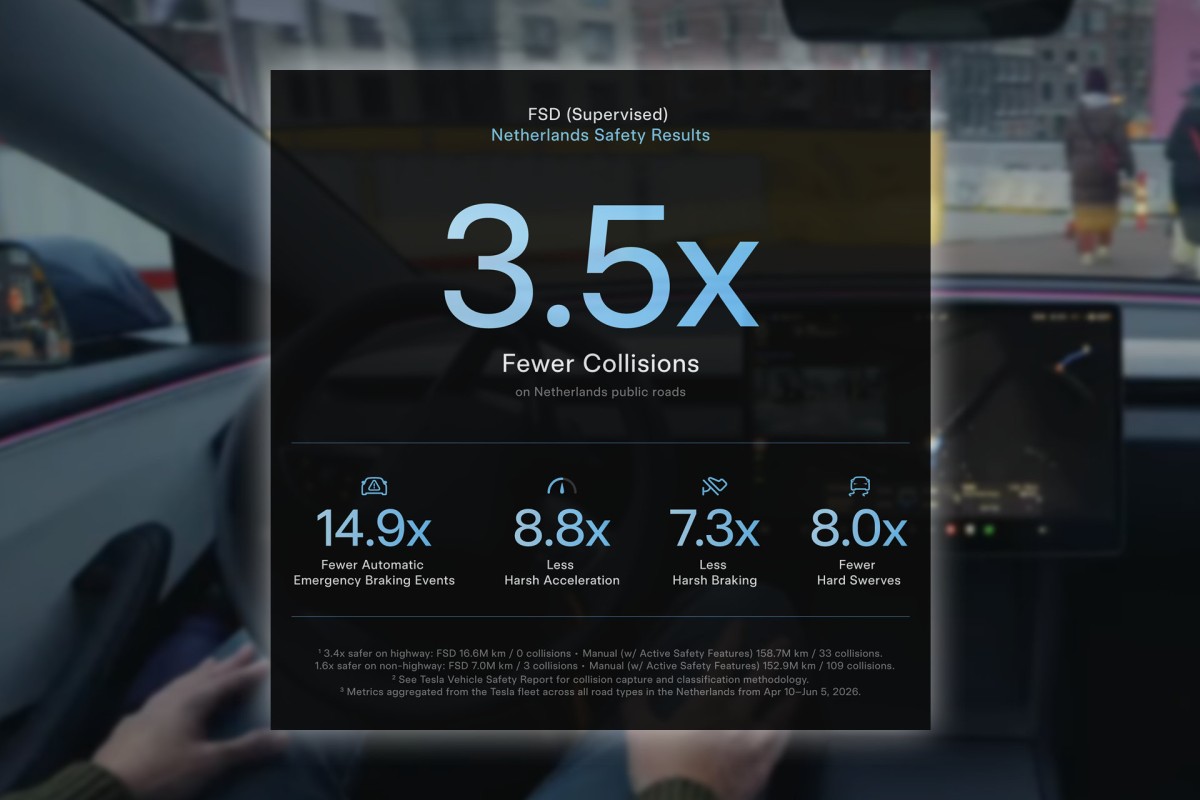
Tesla has released new safety data for its Netherlands fleet, revealing that Tesla vehicles utilizing the Full Self-Driving (FSD) Supervised system were involved in significantly fewer accidents. This finding underscores the potential safety benefits of using advanced driver-assistance systems, sparking interest and debate on the future of autonomous technology.
Veilige Tesla Autopilot Gebruik: A Closer Look
According to Tesla’s report, vehicles equipped with FSD Supervised were 3.5 times less likely to be involved in collisions compared to those driven manually. These statistics, derived from Tesla’s own fleet data, are noteworthy. However, it is important to acknowledge that the details lack certain breakdowns which could provide deeper insights into specific scenarios and conditions.
Understanding the Significance of FSD Supervised
FSD Supervised is an advanced driver-assistance feature designed to minimize driver intervention and enhance vehicle safety. The system uses a combination of cameras, sensors, and machine learning algorithms to monitor the environment and assist with driving tasks. Meanwhile, drivers are encouraged to remain attentive and ready to take control when needed.
Why Veilige Tesla Autopilot Gebruik Matters
The promising data on Tesla’s FSD Supervised comes at a time when the automotive industry is eyes on the safety and reliability of autonomous driving technologies. As a result, these findings could influence consumer trust and regulatory support for such systems. Additionally, the reduction in accident rates highlights the potential for lowering human error, a leading cause of road accidents. A notable example is how advancements in autonomous driving are shifting market expectations, similar to discussions seen in the stroomvraag elektrisch rijden in 2050.
Critics, however, point out that Tesla’s data should be interpreted with caution. The absence of independent verification and lack of comprehensive data segmentation leaves room for questions on specific driving conditions, types of roads, and other influential factors.
Implications for the Future of Driving
The automation of driving tasks is quickly becoming a reality, with Tesla leading the charge in this innovative trend. As more companies develop similar technologies, the Veilige Tesla Autopilot Gebruik could set a benchmark for safety improvements. Therefore, further verification through independent studies and broader data sharing will be essential to assess long-term implications on road safety and traffic regulations.
In conclusion, the significant reduction in collisions reported by Tesla presents a compelling argument for the benefits of autonomous technology. Moving forward, transparency and deeper insights into these findings will be crucial for validating the safety and efficacy of such systems on a global scale.
